
Every now and then, I come across what appears to be a collection that makes no sense. Maybe they aren’t collections but souvenirs that someone bought or collected on a whim, and then just kept adding. And adding and adding.
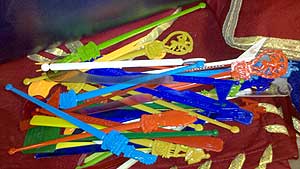
Some of these must be in the realm of hoarding rather than collecting. At auction recently, a large container of cocktail stirrers or swizzle sticks caught my eye. There must have been a hundred or more of the plastic items, all in bright neon colors. They looked to be used, likely taken home from a restaurant or bar after a drink or two.
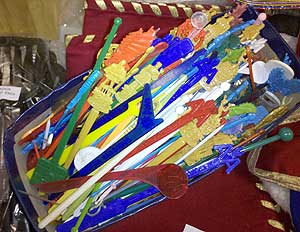
My mind couldn’t grasp the point of collecting them, so I asked the buyer standing next to me. What do you do with a bunch of stirrers? Sit them on your bar in your basement, he said. Another buyer concurred, adding, “I wouldn’t use them, though.”
Neither would I. Would you?
The stirrers sold for $15. Intrigued, I Googled to see if they were auctioned on eBay, where you can buy or sell anything. And I did find them: a vintage lot of 21 sold for 99 cents. 18 sold for $4.99. 40 sold for $10. 59 new ones (clear with colored drinks at the top) sold for $61.
Under the keyword “swizzle sticks,” they sold for far more: 126 for $79. 78 for $30. 250 for $26. 40 Las Vegas sticks from someone’s grandmother’s collection from the 1950s-1970s for $52.
I was dumbfounded. Who collects swizzle sticks, I wondered.
I found out that many people do. And there’s even an association, the International Swizzle Stick Collectors Association, founded in 1985 in Canada. The association is holding a convention in Las Vegas in September. Here’s a 2001 interview with the co-founder Ray Hoare, who says he has more than 50,000 of them. He collects them, he says, because it’s fun.
The first swizzle stick was patented in 1935 by a man named Jay Sindler who wanted an easy way to remove an olive from his drink without using his fingers. He called his new invention the “Swizzle Stick;” it was made of wood with a spear at the end. A Washington Post story from this year noted that the “real” swizzle stick comes from a tree in the Caribbean and is used to stir drinks called swizzles. They go as far back as the 18th century.
The most obnoxious swizzle sticks I found were what most would call black memorabilia: Six vintage “Zulu-Lulu” stirrers – “a conversation starter,” one eBay seller noted, “politically incorrect,” another said – which sold for 1 cent up to $9.99 on eBay. They showed a naked silhouette of an African woman with plump breasts at 15 that sagged as she aged. They were attached to a card that pronounced: “Will make your guests bust out laughing!” “Look what a few years do to Lulu!: Nifty at 15; Spiffy at 20; Sizzling at 25; Perky at 30; Declining at 35; Droopy at 40.”
These tasteless stirrers were made in Hong Kong and were sold as a party gag. They are part of the stereotypical portrayal of black women as jezebels and sex objects. This blogger at Kitsch-Slapped wrote about why she wanted one because they were so horrific, crossed both race and gender lines, and reminded women of what men thought of them.
As for the plastic stirrers at auction, I recall bringing some home when I used to hang out at clubs, but I’d finally throw them away. I’m sure many others have done the same. If I’d kept them, it would’ve been called hoarding, like taking home packets of sweeteners from restaurants.
A couple years ago, I was at an auction preview for the sale of silver coffee sets, paintings, books and furniture from the estate of a woman who lived on the Main Line, a wealthy enclave just outside Philadelphia. In the back yard, spread out over several tables, were about a thousand packets of sweeteners. The folks from the auction house didn’t know what to make of it.
The woman didn’t need to take the sweeteners; she could afford to buy her own. I guess she couldn’t break the habit of just picking up a few packets and dropping them in her purse. I didn’t attend the auction itself, so I’m not sure if anyone bought the stash.
Was that a collection? I think not.

I am about to begin the final cleaning out of my parents home. One of my dilemmas is what to do with my Dad’s swizzle stick and matchbook collections. That’s how I found this site. Most likely there are thousands of each.
Hi Kris. There seems to be a hefty group of collectors of both swizzle sticks and matchbooks out there. You may want to check some of the websites of groups catering to these collectors or you could try an auction house. First, figure out if there are any rare or popular ones among your dad’s collection and then determine what they’re worth via Google and eBay. You’ll find on my blog site some steps for figuring out the value of items.
Sherry
Kris. What I find amazing about swizzle sticks is that they are correctly called “throw away items”…EXCEPT your dad never threw his away… because he probably had something special happen at the bar or restaurant that night and he hung onto them as a keepsake. We’ll both never know exactly what happened but your Dad had plenty of chances to throw them away! I love swizzle sticks that call out the name of a place that you can research. But back to your Dad … I figure any stick that has survived it is because of people like your Dad had some crazy memorable time. They gave a minimum have to be full of Good Karma.
HEY SHERRY;
FOR MORE ON SWIZZLES, PLEASE SEE OUR ARTICLE IN THE LOS ANGLES TIMES
SEPT 16, FRONT PAGE FOOD SECTION NO LESS. YOU CAN GOOGLE THAT OR SEE IF THIS LINK WORKS.
ALL BEST, THE AUTHORS, MADDY LEDERMAN & STEPHEN VISAKAY
http://www.latimes.com/features/food/la-fo-swizzle-stick-20100916,0,6723869.story
Thanks, folks. I’ll take a look. Sherry.
Sherry, as a lifelong swizzle stick enthusiast I am amazed that more people are not aware of the magnificent collections people such as myself have amassed. I currently have over 44,000 swizzle sticks, and the number is always rising. I personally find swizzle sticks to be the most collectible of collectible items. The type of inner peace I feel when finding a new swizzle stick to add to my collection is impossible to describe. Swizzle sticks can bring an expression of joy to any child’s face, which is why I find it important to educate people on these fantastic utensils.
Thanks, Bobby. I’m definitely being educated about the collecting of swizzle sticks. I’d love to hear more about yours.
Sherry